
The Muddy Middle
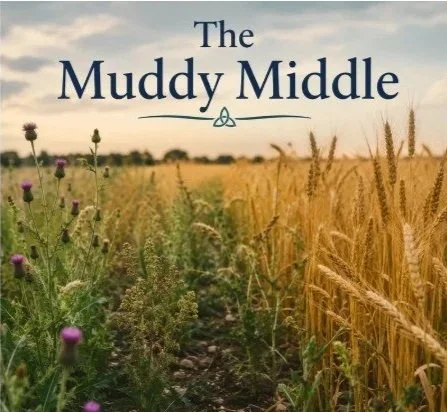
Years ago, as I was preparing for ordained ministry, I found myself returning to the same phrase again and again: we all live in the muddy middle. I probably overused it at times, but this week’s scripture readings reminded me why it has stayed with me.
Perhaps it is also because I was a farmer.
Farmers know that fields are rarely neat and tidy. They are muddy after the rain. They contain both healthy crops and persistent weeds. If you spend enough time walking a field, your boots will eventually collect more mud than you expected.
Life is much the same.
Our world often tells us to think in simple categories. People are good or bad. Right or wrong. Friend or enemy. We are encouraged to make quick judgements and choose sides just as quickly.
Jesus tells a different story.
In this week’s Gospel, a field contains both wheat and weeds. The servants immediately want to pull the weeds, but the landowner tells them to wait. Pull too quickly, and the wheat may be damaged as well. The harvest will come, but now is the time for patience.
The Wisdom of Solomon tells us something equally surprising: God’s strength is revealed through mercy. God judges “with mildness" and governs with great patience. In a world that often mistakes force for strength, scripture reminds us that mercy is one of God's greatest expressions of power.
Paul continues the same theme in his letter to the Romans. Creation itself, he says, is still groaning as it waits for redemption. God’s work is already underway, but it is not yet complete.
This is the muddy middle.
As Episcopalians, we often speak of the via media, the “middle way.” That does not mean avoiding conviction or settling for compromise. Rather, it recognizes that God’s truth is often deeper than the simple either/or choices our world prefers. We follow Jesus, who is full of both grace and truth, justice and mercy. In Christ, God enters the complexity of human life rather than standing safely apart from it.
Most of us spend very little time living at life’s extremes. Instead, we navigate relationships that are complicated, decisions that are not always clear, and days that are filled with both joy and sorrow. We are often, as I have said before, living in the muddy middle.
The good news is that this is not where God abandons us.
It is where Christ meets us.
The muddy middle is where faith is formed, where patience is learned, and where grace quietly grows long before the harvest is visible. It is where we begin to see beyond the weeds and notice that God is still bringing life from the soil.
Perhaps that is the invitation these readings offer us this week. Not to pretend the weeds are not there. Not to deny that life can be messy. But to trust that God’s patient mercy is still at work, even when the field looks untidy.
After all, the harvest belongs to God.
And that is very good news.
Kevin+
