
The Bishop’s Teaching on Discernment ~Misty Urban
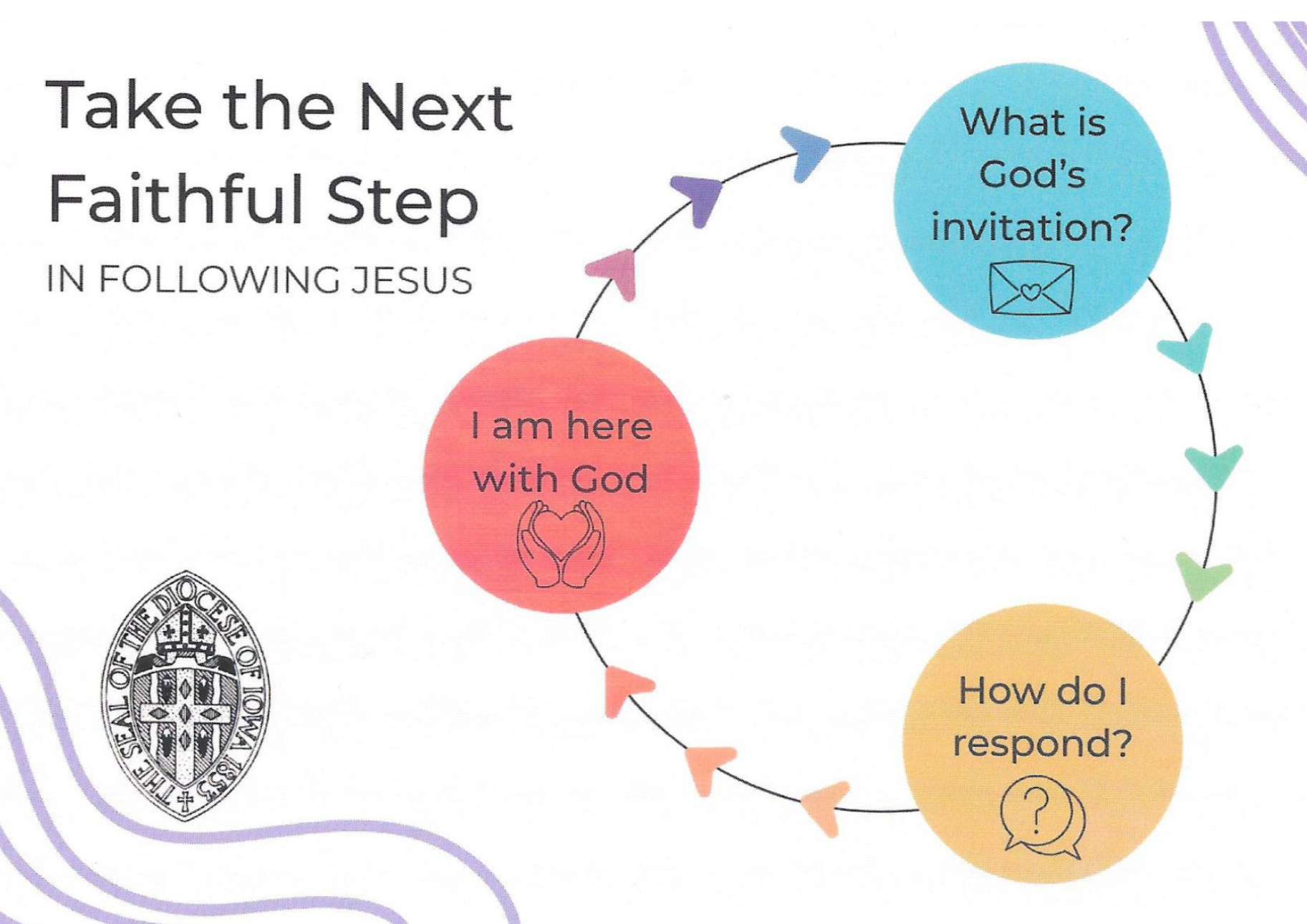
If you were able to attend the workshop after worship with Bishop Betsey on Sunday, August 9, then you’ve already walked through this model of discernment. Maybe it’s already working for you! If you weren’t able to attend, I’d like to describe the steps of the process that Bishop Betsey shared. There’s a lovely graphic to accompany this cycle, and the Bishop left extra copies for us, and I believe Rev Kev has them. Ask him for a copy of the discernment postcard when he returns from his much-deserved vacation.
“Take the Next Faithful Step in Following Jesus”
This is the title on the diagram, and the first invitation: a gentle reminder that discernment is a path of discipleship. We follow this process to listen, understand, and follow Christ. Discernment helps us hear His voice and understand His direction for our lives. Sometimes the message isn’t as obvious as that ad blaring on your radio, webpage, or social media feed, but the results are a closer relationship with Jesus, and who’s going to argue the wellness benefits of that?
The first step of the process is simply presence. We acknowledge, “I am here with God.” This stage is a listening stage. We look around us to see what is drawing our attention, or we look inside to see what is stirring our heart. What is sparking our curiosity or longing? What feels uneasy in our chest? This is where we open our attention and listen intently for God’s message. Sometimes it is a clear voice in our heads. Sometimes it is a quiet tug. Sometimes it is another person who appears before us, showing us the way.
When we identify that spark of curiosity, or that longing we want to investigate, or that need we want to serve; we question some more. “What is God’s invitation?” And then we look around us, and inside us, for answers. God moves our hearts because He believes we are ready and we can serve, but He wants to make this change possible for us. That is where we ask:
What is my ability to respond right now? What are my gifts or strengths? What resources do I have access to that can respond to this need, this call, this invitation?
The answer will come, because by now we are being good students, sitting crisscross-applesauce and very quiet on our squares, listening to our Teacher. He will show us the answer to our questions, which moves us to the third stage:
“How do I respond?” You will see how your gifts and strengths can help in this situation. You will discover you already have access to the resources that can meet this need. This process will, ideally, feel great. This third step leads to more questions, this time reflection as we witness the fruits of our actions. This is where we ask, how have I been changed? How am I growing? What am I learning? We will find ourselves back in that first dot on the diagram: “I am here with God.”
Now let’s admit it. We are not always good students. We have bad days. Sometimes others around us aren’t playing nice. Maybe we had difficulty interpreting the call, or we misjudged our resources, or we misread our strengths, or we made a snap decision when we were hungry and hadn’t eaten our heathy snack. But the beauty is, the discernment process is a cycle. We can listen again to what is stirring, we can identify what doesn’t seem to fit, and we can adjust accordingly. We can trust that He is leading us exactly where He needs us to be.
What I love about this process is that it can be used for all sorts of questions or decisions, grand and life-changing or small and thoughtful. Career, relationships, ministries in the church: this process will work to clarify your understanding and guide your participation through every decision you face. You can use it at every stage of life, and in every aspect of your life.
And the lovely part is, you will be walking the path of discipleship: listening to the voice of Jesus and following in His path, which we know means He is not ahead of us, tapping his wrist and waiting for us to catch up, but rather He is walking beside us every step of the way, offering His arm over the mud puddles.
The Bishop left each of us with a question that will help us begin on this path of discipleship. What is God calling you to do?
I look forward to the discussions on where this process might lead us as a church and as fellow disciples.
With love,
Misty Urban
